Sunday, November 27, 2011

Rocky Mountain High-Boreas Pass

Helianthella quinquenervis and Zigadenus elegans

Calochortus gunisonii with blue butterfy

Helianthella quinquenervis backed by Veratrum tenuipetalum

Delphinium barbeyi

Geranium richardsonii

Cirsium scariosum ssp coloradoense

Linium perenne and Potentilla sp

Pyrrocoma crocea


Calochortus gunisonii


Boreas Pass must be one of those exquisite places where heaven and earth meet.  I rarely have been in such a stunning field of flowers, at least in this country.  Marcia and Randy brought me here, and it was another major highlight of my trip--so many flowers filled this subalpine meadow.  The vegetation was very different from the alpine vegetation on Horseshoe, this was basically a vast field of flowers with forest elements not far away.  Calochortus gunisonii was in spendid abundance, protected from the native rodents by growing in thick grass thatch. which makes it harder for them to get at the bulbs.  It was the major reason for our visit, but there were so many other floral treasures to see too. Helianthella quinquenervis is a nodding sunflower cousin that also is abundant in this area, the nodding flowers probably shelter its pollen from rainstorms, or else must be some strange adaptation to enhance pollination in some way. Pyrrocoma crocea was another (of many) yellow daisy species,  but it bore masses of upfacing flowers from a rosettes of straplike foliage. The toxic Zigadenus elegans is abundant here too, with white spikes of small flowers poking up between more showy flowered plants.  Delphinium barbeyi is a fairly robust plant that forms noticible clumps here and there.  Its blue flowers can be mistaken for Aconitum columbianum from a distance, the latter occurs here too.  Geranium richardsonii has finely veined white flowers and is frequently found as single plants interspersed among the mosaic of other flowers and grasses. Cirsium scopularium ssp coloradoense appears here and there with white flowers on a plant that probably is a biennial or short lived perennial.  Bright blue flax flowers(Linium perenne) stud wispy branches that reach not far above the numerous anthills among the grasses--ants must be a major ecological factor in this area, there were so many of them. A particularly majestic stand of Veratrum tenuipetalum grew in a low damp area, when massed together they were quite striking.  

Thursday, November 24, 2011

Rocky Mountain High-Loveland Pass

Loveland Pass View
Randy and Marcia Tatroe
Me at the sign

Penstemon whippleanus, purple and white forms


P. whippleanus and Castilleja minata
Sedum lanceolatum

Castilleja miniata and Juncus sp
Viola adunca
I had the pleasure of travelling for a day with Randy and Marcia Tatroe, very good friends of Panayoti who are likewise well known in horticultural circles in the Denver area.  They often go hiking in the mountains, and definitely knew the coolest places to go.  Marcia's book, Cutting Edge Gardening in the Intermountain West, is a great read.  I highly recommend it for anyone planning to garden in the region, especially for transplants used to gardening in gentler climates (Colorado IS different......).
One of our stops that day was Loveland Pass, where a well built road leads one right to the top of the pass.  While the flowers were generally not as in their prime as they were at Horseshoe, there were still many nice thing to see.  In this locality one can find different color forms of Penstemon whippleanus, perhaps best known in its darkish purple form, but here alba forms grow along with intermediate purples as well.   Castillejas were abundant, I am tentatively calling what I saw C. miniata, but the different species are hard to tell apart, and some hybridize.  At Loveland they came in various shades of pink and red, and were still looking quite nice.  Perhaps the best specimens of Sedum lanceolatum, a species found wherever I went in the local mountains, were to be seen here.  Its brillant yellow flowers make it quite noticible among other low growing vegetation.  Unlike Sedum acre, which it reminded me of, it clumps but does not run, so I imagine that it would be a far better behaved plant in suitable gardens. A sedge of some sort, perhaps a species of Juncus, is noticibly attractive with dark brown flower heads--it also is seen in various permutations throughout the Colorado mountains.  Finally we came across a colony of Viola adunca, which I have grown before in containers back east, though I no longer have it, I do recall it being easy to grow. 

Sunday, October 9, 2011

Denver-A visit to Kendrick Lake Park and Jim Borland's Garden


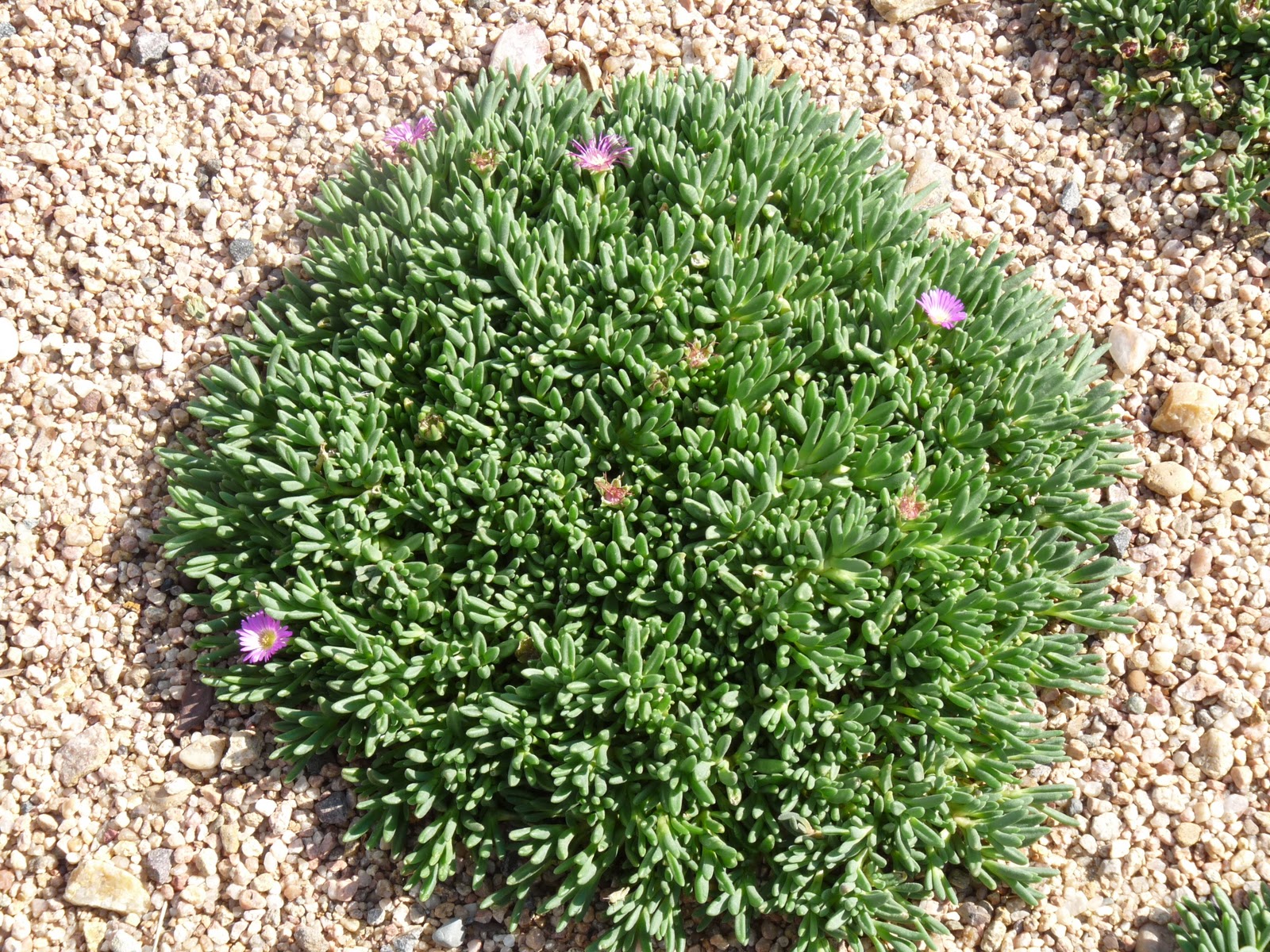
Panayoti was keen on showing me the gardens at Kendrick Lake Park, which had been adding more interesting plants in recent years due to a knowledgable horticulturalist working there.  They suffered a serious hailstorm earlier that year, so some plants had damaged leaves (only tallish ones with broad leaves for the most part) and several had been cut back to remove affected portions.  Still there were a number of interesting plants in good shape to see, some of which resisted the hail and others which were recovering fairly quickly.  Clematis fruticosa "Mongolian Gold" is a shrubby clematis with golden yellow flowers and the typical fluffy clematis seedheads.  It made a small shrub which arched outwards and had many flowers on it.  You really have to click on the photo to see the enlarged version to get a better idea of just how floriferous it is.  A mat of gold in front of a bush of gold describes the combination of the flat growing Zinnia grandiflora and Chrysothamnus nauseosus (rabbit bush).  The zinnia is very different from what easterners think of as zinnia, it is perennial, everblooming, and very weather resistant, though I suspect it would not like our peristant high humidity and precipitation.  Chrysothamnus is a native shrub in the Denver area, and comes in several variants (if not species, there is debate about whether there is one variable species or a group of several species).  Its a good bloomer, and the various variants can basically be any combination of tall/short and green/grey leaved. I believe this is a dwarf form and it is obviously one of the better ones.  Vygies, or mesembs, from South Africa love Denver's sunny and low humidity climate.  While most cannot take the winter cold, many do just fine, and grow to form enormous mats in favored situations.  This one, and the closeup, are Delosperma ashtonii "Blut".  I was too late to see vygies at peak, but this one was still blooming strong.  It is anything but subtle.  The tall red flowered plant is the rare Scrophularia macrantha, endemic to New Mexico but doing fine indeed in this location.  A beautiful but frightening cholla (I think this one is the silver cholla, Cylindropuntia echinocarpa) had an odd out of season yellow bloom.  While theft seems not to be much of a problem in this garden, if it were I doubt this plant would have an issue.  The mere thought of having to weed anywhere near it frightens me! 
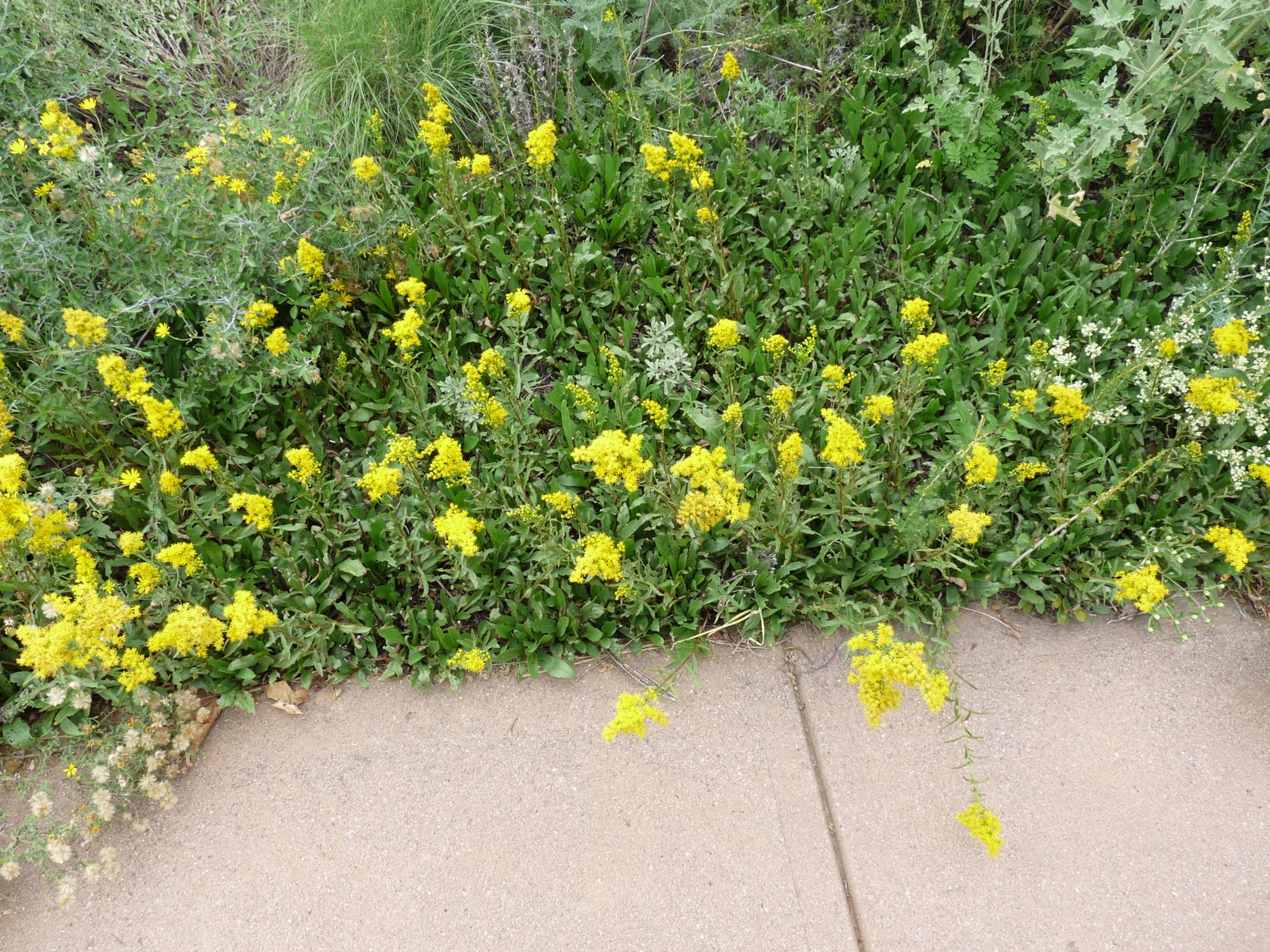
Later we visited the garden of Jim Borland, who is an expert on growing native western plants.  He has quite a diverse collection of natives and some non natives on his suburban property.  It was cool to see a Buffalo gourd (Cucurbita foetidissima) wandering around the front sidewalk.  This one splays itself over a saltbush (Atriplex canescens) in its quest, like many cucurbits, to conquer the world.  The fruit is attactive but not edible, though apparently the seeds are okay to eat.  It is a perennial vine that produces absolutely massive roots, from which the vines radiate outwards during the growing season, only to die back completely when colder weather sets in.  Jim had two species of dwarf goldenrod, this one is Solidago nana.  It makes a showy edging/groundcover looking its best in the difficult garden month of August.  The next two photos are of Cleome lutea, a southwestern native species not often tried in gardens.  It makes a nice contrast to the larger flowered but unpleasantly prickly stemmed garden cleome (C. hasslerana), and a good companion for the native lavender Cleome serrulata, which seems to be more commonly grown in Denver area gardens.  I was thrilled when Jim gave me a good supply of seeds to try it next year in my gardens. There are a few non natives in his garden too, and this quince, Cydonia oblonga "Pineapple", was one of them.  This cultivar was bred by Luther Burbank.  Quince is an odd fruit originating in caucasus area of western Asia.  The large fruits require frost action (bletting) to soften them so as to render them edible, hence they are not the kind of thing one sees in grocery stores.  I was way too early to taste one, but it was a cool fruit to see anyway!