Senecio is an overly large genus spanning just about all the continents, except Antarctica of course. No doubt it will (or has?) be broken up into separate genera by the molecular cladists. However at this time one of the peculiar things is that in a genus of overwhelmingly yellow flowered plants there are several from the southern hemisphere that are shades of purple. I know of at least one species in South America, but the ones I am most familiar with grow in South Africa. Three cold hardy species find my gardens very much to their liking, and all three are blooming now. The first species, Senecio macrocephalus, is the lowest growing of them, and also puts on the briefest show. It is in peak bloom now, forming a sea of color in the front garden and also in spots in the back gardens. Flowering lasts a few weeks and soon copious amounts of seeds will set. These fly in the manner of dandelions and germinate quickly to start more plants which will add to next year's show. The fleshy leaves lie on the ground in a rosette and are wider than the other two species I grow.
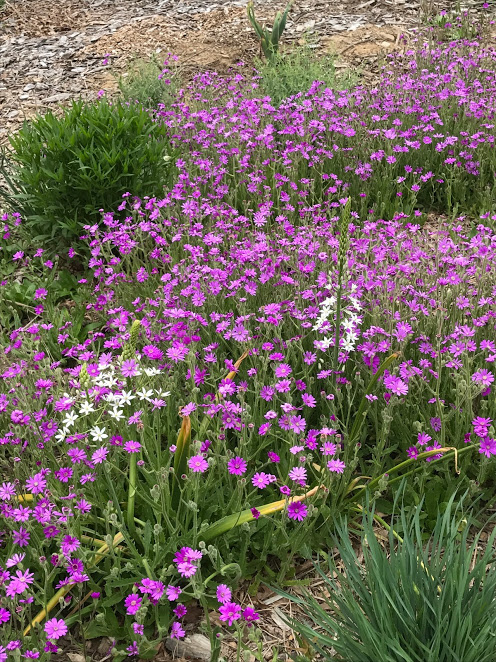

Senecio polyodon grows in boggy areas in the Drakensberg and was the first of the purple South African senecios to be introduced into the US. Panayoti Kelaidis of Denver Botanic Garden collected it on his first expedition to S, Africa and it remains in cultivation in the US and Europe to this day, though I would not say it is common in the US. It produces smaller flowers than S. macrocephalus on slightly taller stems. The foliage is not as succulent either and is long and narrow by comparison. It is beginning to flower and will flower for well over a month if conditions are suitable. It will also self seed, but not as robustly as S. macrocephalus. In fact I have to rouge out seedlings of S macrocephalus to keep it from outcompeting S polyodon.

The third species is not yet identified, but came from the Tiffindell ski resort area of the Drakensberg so I refer to it as Senecio sp. "Tiffindell". It is the only one of the three species that is stoloniferous in addition to self sowing. So it is able to grow into a large patch rather quickly. It flowers quickly, within a few months from seed. Flowers are bigger than S. polyodon but a bit smaller than S. macrocephalus. It does a mass flowering right now, with sporadic blooms appearing the rest of the season. It is at least as vigorous as S. macrocephalus in my garden, and while it might not out compete the latter since its leaves are not as large, its ability to spread by thin stolons does give it an advantage over the other two species.
All three species are readily grown from seed and appear to be quite cold hardy. They do not appear to be hybridizing as far as I can tell, though they are rather similar in appearance and in peak bloom time. They also like moist soil, though they do tolerate some drought in summer after their main flowering period. Lately it has been quite cool and rainy, in fact this is probably one of the coolest and wettest springs I can remember, and all three senecios are doing extremely well. The mild winter also resulted in practically no dieback of the foliage so that helped too. None of them like really hot weather, though they don't suffer much here in New York but I am not sure if they could deal with the summertime heat of places like North Carolina. As with most Asteraceae it is best to grow a few plants from seed to ensure that fertile seed is set as many Asteraceae are self infertile. Individual plants of these senecios may not live beyond a few years so having seed as a backup (or seedlings coming along, which will happen if there is bare ground nearby) is the best way to ensure that one will be able to enjoy swathes of senecios for years to come.


